
MOKA methodology
Protégé
Knowledge acquisition can be carried by structuralised interview by an engineer who has a command of MOKA methodology or independently by a designer, however, it is necessary for a designer to get to know with informal knowledge model from MOKA methodology.
MOKA methodology
MOKA (Methodology and software tools Oriented to Knowledge based engineering Applications) is a name given to a methodology of research project which formed a part of ESPRIT program. It was assumed to work out the following:
- knowledge representation forms of a product and its designing process as well as the methods of its record,
- computer application for aiding record, representation and managing of the knowledge,
- possibilities of further automatic generation of KBE application code from computer application.
Informal model covers five kinds (fig. 1) of ICARE forms (Illustration, Constraint, Activity, Rule, Entity):
- illustration,
- constraints,
- activity,
- rule,
- entity.
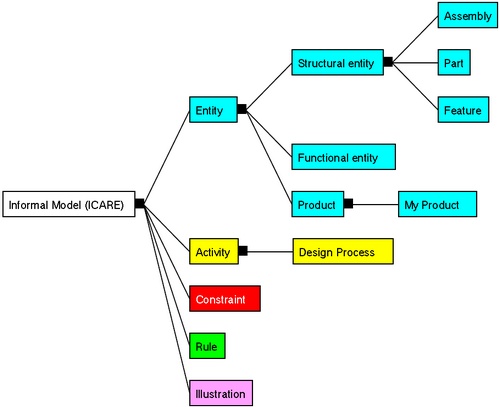
Fig. 1. Informal model of MOKA methodology
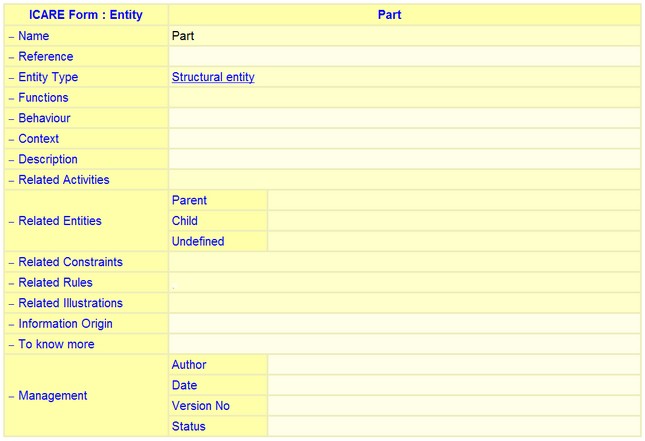
Fig. 2. ICARE (PCPACK) form
Entity form serves for obtaining knowledge concerning product structure by means of specialised Structural entity forms. The following structure elements of a product are possible: Assembly, Part, Feature. What is more in the Entities it is possible define Functional entity and Behavioural entity. Entity forms together with Activity forms constitute the most important forms for knowledge acquisition. Entity forms reflect the structure of a designed product whereas Activity forms the structure of designing process. Both structures are correlated by means of relations which can be defined and observed in a table (fig. 2) or a ladder. At the same time Functional entity and Behavioral entity are connected with product structure elements by means of which functions and behaviour of product elements are defined. Additionally it is possible to define extra forms Constraint and Rule. Constraint forms allow defining additional limits to product structure elements and first of all to Feature. Whereas, Rule form allows determination of rules for designing process activities. By means of additional form Illustration it is possible to add extra information to each of the previous forms. It all forms multilayer network by means of which it is possible to acquire knowledge fist of all from experts but also from other sources. At the same time the complexity of net model does not have negative influence on the simplicity of interface which implements knowledge - they are forms of only five repeating types.Completely different task has the second model from MOKA methodology i.e. formal model (fig. 3) which is recorded in MML (MOKA Modelling Language) which in turn is a profile of UML language. The profiles are one of the mechanisms of extension of functionality of UML language to specialised domains. The profile of UML language is most commonly a set of packages and is defined by three groups of elements: stereotypes, tagged values and constraints. Formal model forms a structure of knowledge base, whose representation by assumption should be understood for a man and at the same time processed by computer system. Base structure is, as far as main elements are concerned, defined permanently and consists of Product Model and Process Model. Product model forms a base for further information which includes five defined views on the product structure, which shapes separate namespaces and packages of MML language. These views are: structural, functional, behavioural, technological and representation. Both views and models of these views allow knowledge classification. The knowledge base itself is created with the usage of formal model from identified knowledge and preliminary structuralised by informal model and ICARE forms.
Additionally the models use identified attributes and relations (fig. 4), which are used in both formal and informal model.
Formalism of models' record which is guaranteed by the usage of MML language enables a possibility of further processing by computer systems. Conceptually the language is to serve for creation of KBE application, which would use knowledge base created on the basis of formal model. MOKA methodology does not aim at cooperation with any CAD/KBE system but it suggests universal way of knowledge representation with the issue of KBE system creation as an open issue.
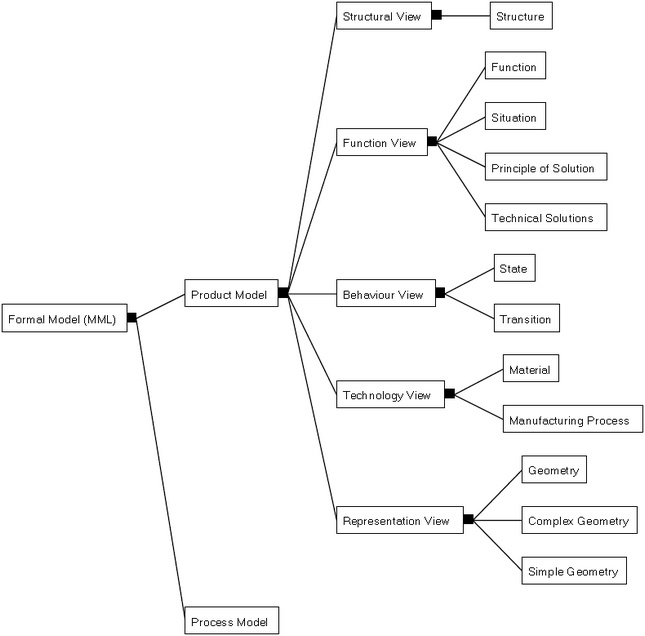
Fig. 3. Formal model of MOKA methodology
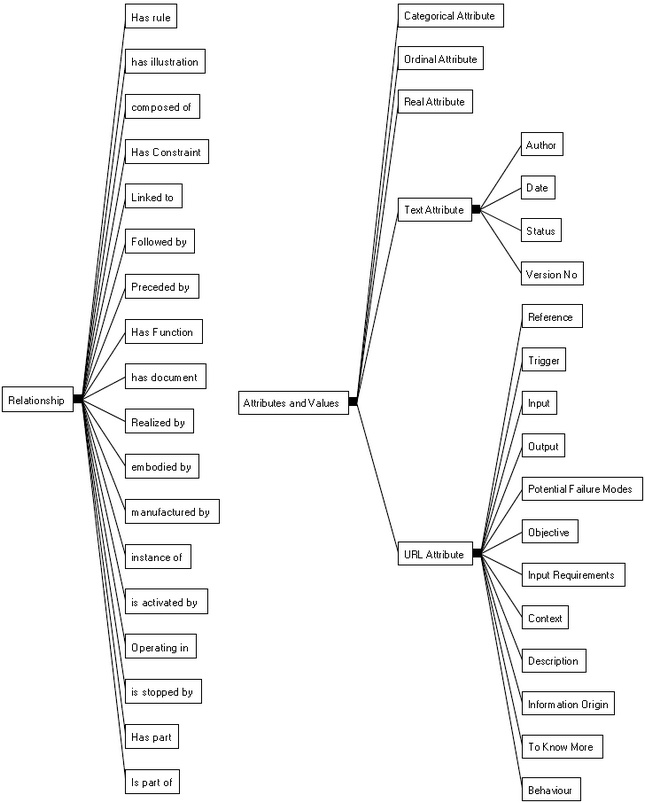
Fig. 4. Relations and attributes used in MOKA formal and informal model
Furthermore, apart from the above mentioned models, MOKA methodology describes processes of identification, acquisition, gathering and management of knowledge and points to the computer program tool for realization of theses tasks. Regardless of a tool which has been elaborated in MOKA project other tools e.g. PCPACK or Protégé can be used for the creation of models compatible with MOKA or similar to MOKA approach.^ to the top
Protégé
Protégé is a free open source tool, it is an application which aids creation of knowledge bases, including ontology edition and knowledge acquisition from experts. This process is sometimes known as knowledge modelling.
Protégé platform allows the usage of two forms of knowledge representation by means of two autonomous applications Protégé-Frames and Protégé-OWL. Ontologies are created by means of Protégé application and can be exported to many different formats including RDF(S), OWL i XML Schema.
Protégé application is in Java language and one of its advantages is the ability to expand application functionality by means of plugins and ontologies available for that platform. There is a possibility of independent extension of application possibilities by making plugins for application by oneself and creation of one's own ontologies.
^ to the top